

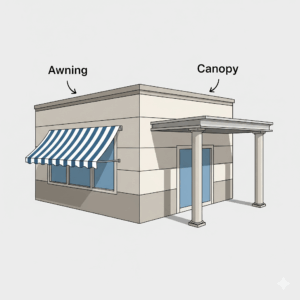
 In New York City, people often use “awning” and “canopy” as if they were the same thing. They are not. An awning is a façade-mounted projection, fixed or retractable, that shades windows and doors, cuts glare, reduces heat gain, and adds a branded edge at the sidewalk. Because it mounts at the wall and can fold away if motorized, an awning delivers sun and light rain control without posts in the public way. A canopy is usually freestanding or post-supported, and it creates deeper, structural coverage for entries, walkways, or pickup zones. Canopies feel more architectural, for example a crisp aluminum cover at a hotel drop-off or a durable metal marquee at a clinic entrance.
For owners and managers, the difference drives permits, longevity, and guest experience. Awnings excel at storefront branding and selective shade in dense retail corridors. Canopies win when you need year-round weather protection and a clear “this is the entrance” signal. You will also navigate NYC right-of-way rules, mounting heights, and historic-district aesthetics. If you are starting research, see façade options under Commercial Awnings, and review permanent entry solutions under Mapes Metal Canopies.
Types of solutions
Façade-mounted retractable awnings, manual or motorized
Great for cafés, boutiques, and offices that want shade on demand without posts at the curb. Motorized units pair well with wind sensors for self-protection and carry clean, legible graphics on the valance or face. Explore Commercial Awnings for models and use cases.
Fixed frame fabric awnings
A classic for consistent coverage at doors and display windows. With the right textile, stitching or welds, and edge details, fixed awnings provide a sharp line and dependable shelter with straightforward maintenance. They work well for multi-bay retail that needs a cohesive look.
Architectural metal canopies
When impact, longevity, and crisp geometry matter, post-supported aluminum systems are hard to beat. They handle snow and wind loads, integrate drainage, and provide strong wayfinding at the entrance. See examples on Mapes Metal Canopies.
Extended-area shade structures
For courtyards, pickup lines, or larger gathering zones, engineered frames with tensioned membranes or louvered roofs provide programmable shade and rain protection, often independent of the façade. Learn more under Shade Structures.
Hybrid storefronts
Many NYC projects combine a slim retractable at the glass line for daily glare control with a shallow metal canopy at the main door for obvious weather cover. The result is a layered, high-function façade.
How to choose between an awning and a canopy
1) Purpose and depth of coverage
If your goal is solar control and brand presence with minimal sidewalk impact, choose an awning. If you need dry footing in a downpour, protected queues, or dignified arrival, choose a canopy.
2) Site conditions, loads, and durability
Corner winds, southwest exposure, and freeze-thaw cycles stress hardware. Awnings benefit from robust frames, quality textiles, and smart automation. Canopies bring structural aluminum, integrated gutters, and high-load anchorage.
3) Permits, clearances, and districts
NYC rules dictate projection, height, and post placement. Historic districts often prefer restrained colors and traditional profiles. Specifying systems proven on city streets can speed approvals.
4) Brand and visibility
Awnings shine for graphics, for example logo on the valance and color-blocked fields that read at a glance. Canopies can carry dimensional letters and integrated lighting. Either route should express your standards without clutter.
5) Operations, maintenance, and access
Motorized awnings with wind sensing reduce staff burden. Canopies need periodic cleaning and gutter checks and often deliver a longer service life. Choose what fits how your team works day to day.
6) Budget and phasing
Awnings are often the fastest path to impact. Canopies are a capital investment with architectural payoff. Many owners phase work, starting with a façade awning and adding an entry canopy as needs grow.
Style and function by business type
-
Retail and boutiques, SoHo to Williamsburg
A slim, color-true awning frames displays without blocking views. Add a straight or scalloped valance for identity. If you host lines in bad weather, pair it with a compact metal canopy at the door. See Commercial Awnings. -
Hospitality and cafés
Retractable awnings create flexible microclimates over sidewalk seating. Use the valance for branding and specify drop valances for late-day glare. A compact canopy at the entrance keeps guests and host stands dry year-round. -
Healthcare, schools, and civic sites
A clear, durable canopy establishes wayfinding and ADA-friendly dry zones. Aluminum systems from Mapes Metal Canopies handle heavy use and simplify upkeep. -
Mixed-use and campuses
Combine storefront awnings for glare control with larger Shade Structures to unify outdoor areas and circulation.
Choosing between an awning and a canopy is not an either or decision. It is about the right tool for your frontage, climate, and brand. If you want elegant solar control and signage with a small sidewalk footprint, start with an awning. If you need unmistakable, all-weather arrival and deeper protection, a canopy earns its keep. Our team designs, fabricates, and installs both, code-compliant and tuned for NYC streetscapes. Explore Commercial Awnings for façade options, and see how entry canopies elevate presence on Mapes Metal Canopies.